The Next Great AI Seller Might Be an Engineer
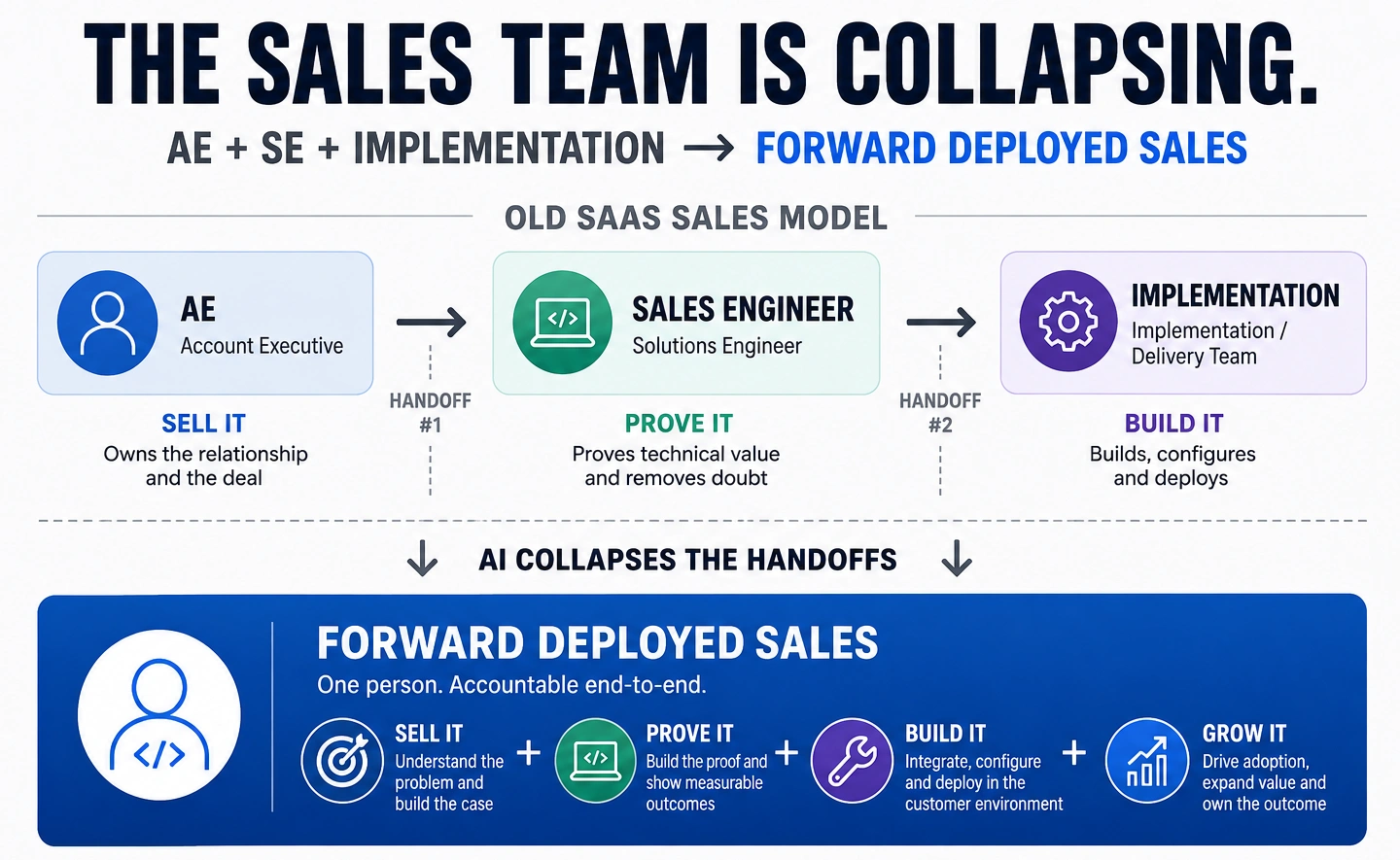
What if the person capable of building the proof also owned the commercial outcome? Part builder, part seller. One person accountable from the first technical discovery through proof of concept, commercial close and account expansion.
Aug 26, 2026
Eighteen months ago, "Forward Deployed Engineer" was a Palantir oddity. Today it's one of the hottest job titles in tech.
FDE-style roles grew 42-fold between 2023 and 2025, and job postings jumped over 800% in the first nine months of 2025 alone. AWS has put a billion dollars behind building an FDE team. Microsoft has gone further, launching a $2.5 billion unit built around roughly 6,000 people behind its new Frontier Company. Salesforce, Adobe, Google Cloud, EY, Accenture are all doing versions of the same thing.
Something bigger than a new engineering job is happening here. The traditional split between the person who sells the software and the person who makes it works is starting to break down.
I think that it will lead to a whole new type of role that we don't have a name for yet. I'm calling it Forward Deployed Sales.
Why this is happening
For most of the SaaS era, the division of labour made sense. The AE owned the commercial relationship. The Sales Engineer (SE) proved the technology. Once the contract was signed, implementation or Customer Success took over.
AE sells it > SE proves it > someone else deploys it.
That works only when the product is reasonably standardised. AI however simply isn't. Every enterprise has different data, systems, workflows , security constraints and definitions of success. Increasingly, selling an AI product means proving that it can work inside of that customer's environment.
And a polished demo doesn't answer that question. Something has to be built. That's the first reason why FDEs are exploding - AI has broken the "buy it, plug it in" assumption that most of SaaS was built around.
The second reason is speed. AI capability moves in months, sometimes weeks. A slow, separate sales then implementation process is too slow to matter. The proof and the deployment need to happen together.
The third reason is commercial. If an engineer builds the first workflow, integration or agent that creates genuine value for a customer, they've done more than implement software. They've created the basis for expansion. The old boundaries between pre-sales, delivery and growth start to look fairly arbitrary.
But I think that FDEs are only halfway there
At most companies adopting FDEs today, the engineer is getting pulled much further into the commercial motion. They help win the customer. They build the proof. They deploy it. They help expand the account. But someone else still owns the number.
That makes sense at OpenAI, Palantir or Microsoft, where you can afford multiple senior people around a strategic account. It makes less sense for a growth-stage AI company.
If you're selling a complex AI product into the mid-market, can you really afford an AE, an FDE, implementation and Customer Success around every significant deal? I suspect a lot of companies can't.
Which raises a more interesting possibility:
What if the person capable of building the proof also owned the commercial outcome?
Part builder, part seller. One person accountable from the first technical discovery through proof of concept, commercial close and account expansion.
That's what I mean by Forward Deployed Sales.
Which is easier to teach - a builder to sell, or a seller to build?
For twenty years, sales hiring worked one way - hire Sales first based on their commercial instinct, executive presence and the ability to close. Then hand them a Sales Engineer for technical backup. The assumption was that selling is the hard, rare skill, and technical depth can just be bolted on, often 3+ months after the salesperson has started.
I don't think that holds anymore.
Real technical credibility takes years to develop. If you're sitting opposite a customer's engineers and claiming you can transform one of their core workflows, eventually there's a pass/fail test:
Can you actually build something they respect? That is hard to fake.
Selling is hard too. Great enterprise sellers understand organisational politics, create urgency, build consensus, navigate procurement and negotiate complex deals. I'm not arguing that an engineer can learn all of that in a weekend.
I'm arguing something narrower.
Technical capability has a harder minimum floor.
A technically weak person eventually gets exposed when the thing doesn't work. A strong engineer who is merely good rather than exceptional at discovery, stakeholder management and negotiation can still create enormous commercial value, particularly when the strongest closing argument is a working system.
That's why I'd increasingly hire from the technical side of the line and teach commercial capability, rather than doing the reverse.
Why Forward Deployed Sales makes sense
The person proving the value owns the outcome. There is no artificial break between "selling" and "delivery." The person who told the customer it would work is accountable for making it work.
You're selling outcomes, not seats. Seat-based software could be sold largely through features, ROI modelling and negotiation. Outcome-based AI increasingly requires proof. If the customer is buying fewer support tickets, faster underwriting, automated workflows or higher conversion, showing that outcome on their own data is far more powerful than presenting another slide.
The work compounds. A good forward deployed engagement leaves something behind, either an integration pattern, workflow, data model, agent architecture or reusable component. The next deployment gets faster. A demo usually doesn't compound that way.
The economics work better for smaller companies. Most growth stage companies can't put an AE and senior FDE on every meaningful opportunity. One expensive hybrid person may actually be cheaper than two specialised ones. And perhaps more effective.
Who's already doing this
Ramp's FDEs work directly with GTM teams to help close deals, activate customers and expand accounts.
Adobe says its forward-deployed engineers own the lifecycle from the first customer conversation through production deployment.
Salesforce describes its FDEs as hands-on builders responsible for measurable business impact.
Sierra has gone even further on the business model itself, pricing around customer outcomes rather than traditional software seats.
Palantir still separates Forward Deployed Engineers from roles such as Deployment Strategists, but both sit remarkably close to the customer's operational problem.
None of these companies calls the combined role Forward Deployed Sales. But the boundaries are clearly moving.
So what happens to the traditional AE and SE?
Here's the part I suspect will be controversial.
I think the relationship only AE may be more exposed to AI than the SDR.
Most predictions about AI and sales start at the bottom of the funnel by automating prospecting and the SDR disappears.
Maybe.
But look further up the sales organisation. The AE whose primary value is relationship management, process orchestration and negotiation, while an SE supplies the technical credibility, is also vulnerable. Because you can't relationship-manage your way to a working AI deployment. Either it works on the customer's data, inside their environment, or it doesn't.
Great enterprise sellers aren't going anywhere. People who can navigate organisations, build executive consensus and create urgency will remain incredibly valuable. But they'll need more technical depth.
For Sales Engineers, I think the message is similar. The SE only lane of "demo, answer technical objections, hand over" looks increasingly narrow. The opportunity is to move deeper into building, deployment and commercial outcomes.
And for FDEs, there's another step available. Don't just own whether the technology works. Learn to own why the customer should buy it, what the outcome is worth, how the organisation makes the decision and what happens commercially when it succeeds.
Because the most valuable technical seller of the AI era might not be an AE with an engineer standing beside them.
It might be the engineer who learned how to sell.
That's what I mean by Forward Deployed Sales. And I suspect we're going to see a lot more of them.
I'm particularly interested in hearing from people building AI GTM teams. Are you already combining technical delivery and commercial ownership? And if you've tried it, where does the model break?