How to Run a Sales Forecast Meeting That Isn't Just a Status Update
Sales forecast meetings usually run long and still miss the mark. Here's how to structure the conversation around evidence, not optimism, so the number you call is one you can actually defend.
Aug 27, 2026
Selling
Most forecast meetings are pure theatre. A sales rep reads out stage and close date, a manager nods, a number gets typed into a spreadsheet nobody trusts, and everyone leaves having learned nothing they didn't already know from the CRM the night before. Then the quarter closes 20% under what was called with confidence in week 10, and nobody can explain why.
Here's the fix - and it isn't a better template.
First, know what this meeting is for
A forecast meeting has one job - decide, with evidence, what number you're calling for the period and why. It's a backward looking evidence check on a specific set of deals. It's not a deal review and not a pipeline meeting. If a deal needs a strategy discussion, that's a sign it doesn't belong in the forecast conversation yet.
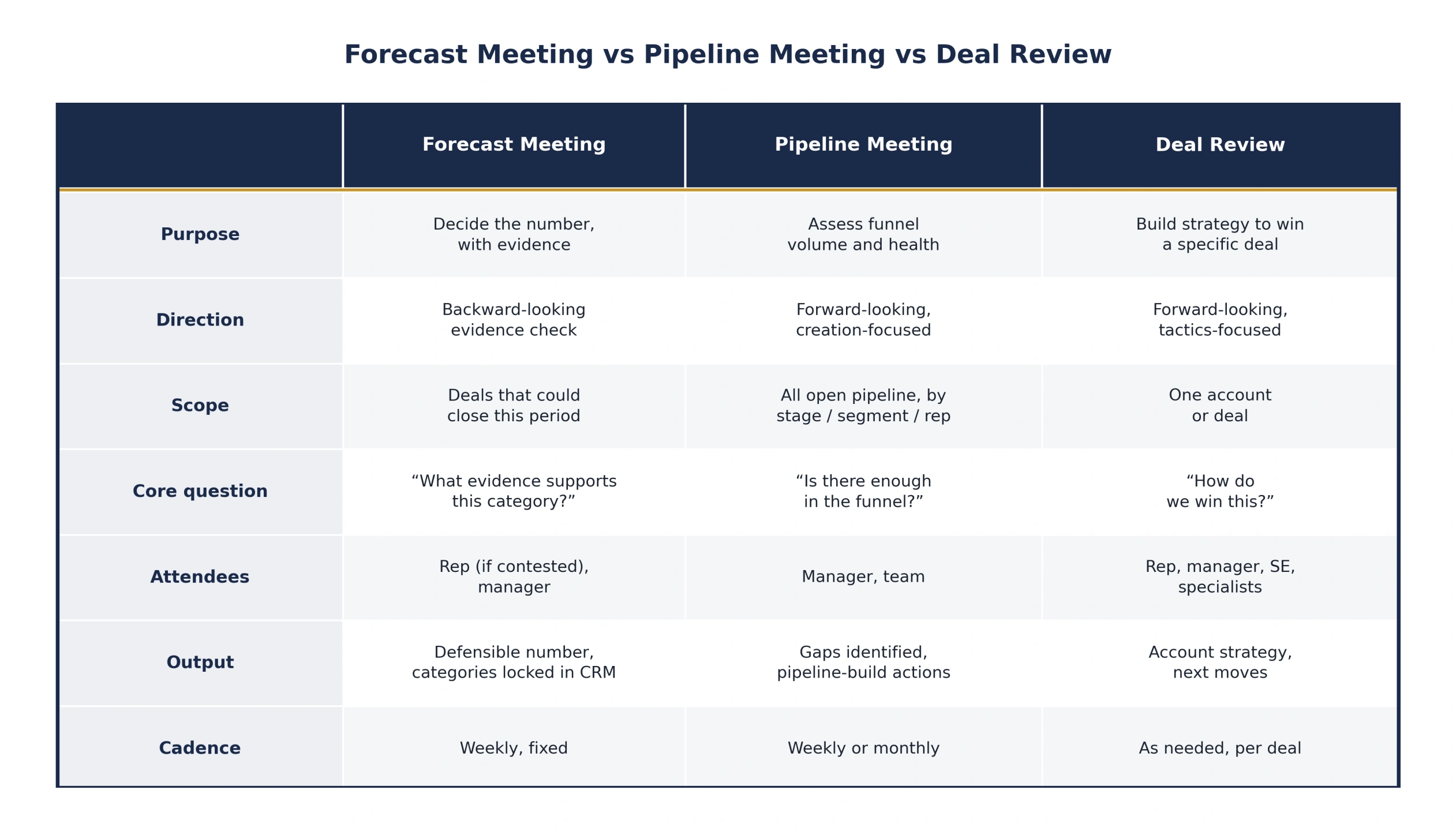
Keeping this boundary sharp is what makes everything else here possible. The moment a forecast call drifts into "so what's our play here," you've blown the time budget and talked yourself into optimism you can't defend on evidence.
Why accuracy actually matters
Forecast accuracy is the input to hiring plans, quota setting, marketing spend, and how much rope you give a rep before you intervene. A forecast that's wrong by 30% isn't a rounding error, it's a leadership team making resourcing decisions on fiction.
The CRM is the only source of truth
No side spreadsheets, no verbal updates living in someone's head. If it's not in the CRM, it doesn't exist for forecast purposes. If you allow a shadow system (a personal tracker, a deal doc etc) and you've told your team the system of record is optional, and now you're reconciling two versions of reality every week. The CRM being messy is a data hygiene problem to fix, not a reason to route around it.
Define your three cases - and mean it
Worst Case: what closes even if nothing goes your way. Committed deals only - signature imminent.
Most Likely: your real number, the one you'd bet your own commission on. Validated business case, economic buyer engaged, mutual close plan with dates the customer agreed to - not dates the rep decided upon.
Best Case: everything in Most Likely, plus deals that could close if every remaining variable goes your way.
Judge the category on evidence, not stage
A deal belongs in Most Likely when you can tick these, not assume them:
Named economic buyer has had a direct conversation with you about budget
Mutual action plan exists with dates set by the customer, not the rep
Procurement or legal is actively engaged, if the deal size requires it
SE has confirmed technical validation is complete or on track
Rep can answer "what happens if this doesn't close this quarter" without hedging
Miss any of these and the deal is Best Case at best, regardless of what the stage field says.
Rep number vs manager judgement
Your rep doesn't own the forecast. They own their deals. You own the forecast. Never call a number upward that you can't defend without the rep in the room.
Every rep has a bias, and it's more stable than people think. Some sandbag, some are chronically optimistic, a few are dead accurate and get ignored for it. Track each rep's forecast against actual closed-won over a few quarters and the pattern becomes a known constant you can correct for mathematically instead of re-litigating every week. It's often rational, not a character flaw. And the same distortion repeats one level up: ask your own skip-level what they think your bias has been. Most managers never ask.
Deal probability, weighted pipeline, and coverage
Weighted pipeline (probability × deal value) is a reasonable macro signal but a poor micro tool. Why? Because the probability field is usually just a stage proxy, set once and never revisited. Use it to sanity check the aggregate, not to defend an individual deal.
Coverage is where most forecast meetings quietly lie to themselves. Total pipeline coverage tells you almost nothing as it's inflated by deals that will never close. Weighted coverage is better but inherits the same sloppiness. The number that actually predicts whether you'll hit target is Most Likely coverage against quota . If those deals alone don't cover quota with room to spare, no amount of Best Case optimism fixes that gap. Good managers track all three, but run the meeting off the third.
The meeting changes shape through the quarter. Its job doesn't
Pipeline creation belongs in the pipeline meeting, full stop, at every point in the quarter. What shifts is where the evidentiary bar sits:
Early quarter: category calibration, coverage against target, flagging forecast risk early.
Mid-quarter: category movement, slippage tracking, closing evidence gaps.
Late quarter: ruthless scrutiny of Most Likely ie: exactly what remains between today and signature.
Before the meeting: a five-minute manager checklist
Review this before you join the meeting, not during:
Most Likely vs quota
What changed since last week
Deals entering or leaving Most Likely
Deals that have slipped
Deals in Most Likely for 2+ cycles
Rep forecast vs manager forecast
AI/model disagreement, if available
The 20-minute forecast meeting
The meeting starts and ends with the number. Everything in between exists to test whether that number holds.
3 min - Call the number. Most Likely vs target. Change from last week. Manager call vs team call, stated up front.
12 min - Challenge the exceptions. Only deals that entered, left, slipped, or have sat in Most Likely for multiple cycles, or show a material rep/manager disagreement. For each deal discuss "What evidence changed?"
3 min - Call the number again. Has anything just heard changed the forecast?
2 min - Lock the actions. Category changes into the CRM. Owner, action, date, on the spot.
Forecast accuracy isn't really a forecasting problem. It's a management courage problem.
The CRM can show you the deals. AI can show you the signals. The rep can tell you what they believe. But eventually a manager has to say: "I don't see enough evidence to call this Most Likely." That's the job.
A good forecast meeting doesn't produce more discussion. It produces a number the manager is prepared to defend.
Dan Bognar is a former Managing Director & VP Sales APJ at HubSpot, GM & VP Sales APJ at DocuSign and COO & EVP APAC at Salesforce. He is the founder of Growth Getters, where he coaches B2B technology Sales Managers, Directors and VPs.